
Your Puppy's First 90 Days: The Real Feeding Guide
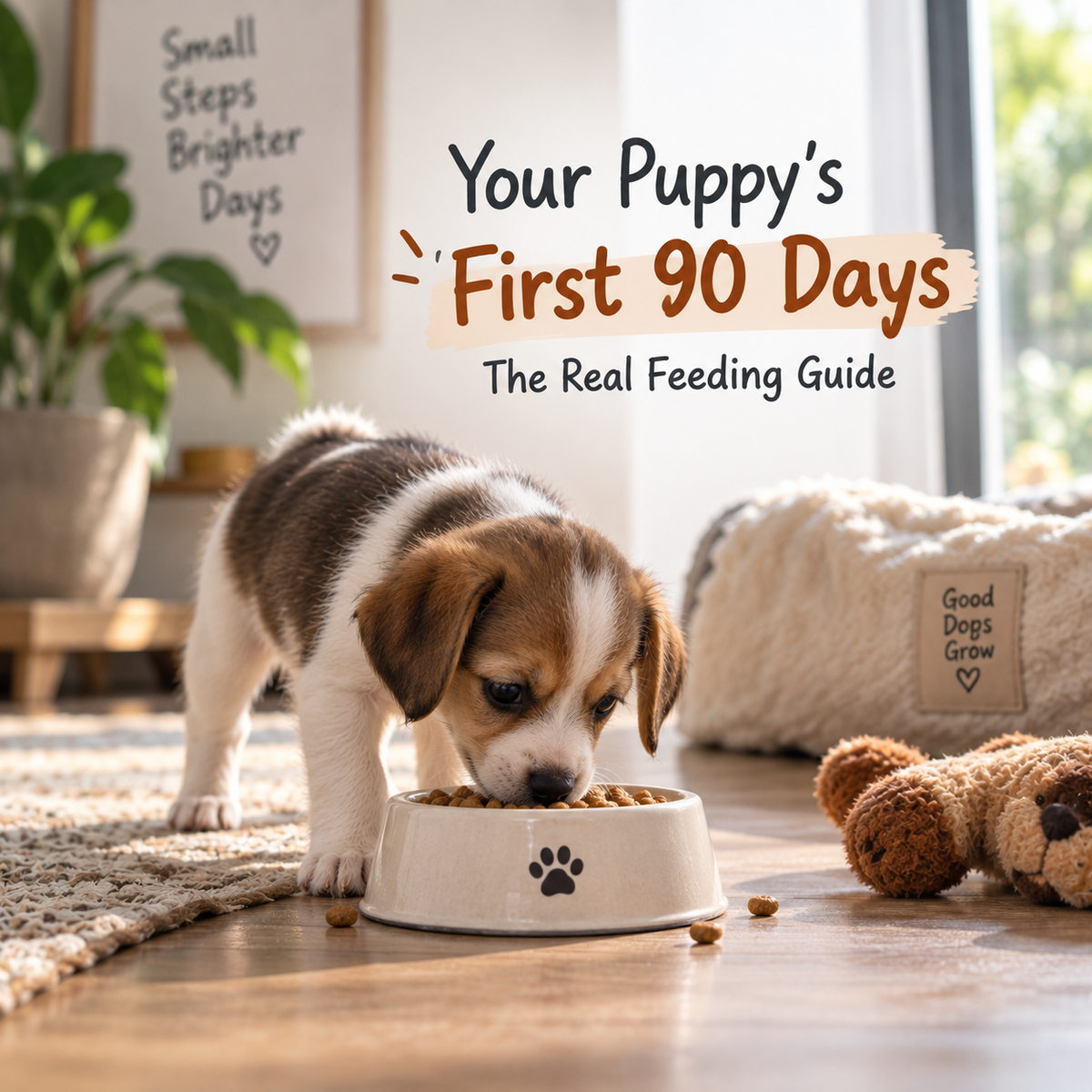
The first three months are the highest-stakes stretch of feeding a puppy will ever go through — this is when their body is growing fastest, which means mistakes here matter more than they will later. Here's what actually matters in this window.
Start With What They're Already Eating
Before you bring your puppy home, ask the breeder or shelter exactly what they've been fed. A responsible one will send you home with a few days' supply — if a puppy isn't already weaned onto solid food by eight weeks old, that's a red flag worth walking away from.
You can keep them on that same food, or switch once they've settled in. If you switch, stretch it over 7 to 10 days: mix a small amount of the new food into the old on day one, then gradually shift the ratio until the old food is gone. Skip this and you're likely looking at a genuinely upset stomach.
If Your Puppy Isn't Even a Month Old Yet
Everything above assumes a puppy already eating solid food. If you've ended up with one younger than that — often the case with an abandoned litter, or a stray found without its mother, which isn't unusual in Indian neighbourhoods — the rules change completely, and it's worth knowing before you improvise.
A puppy under 4 weeks old shouldn't be eating solid food or kibble at all. Their only source of nutrition should be a commercial puppy milk replacer, fed every 2 to 4 hours around the clock, according to VCA Hospitals. Warm the formula close to body temperature before each feed, always feed them belly-down rather than on their back to avoid choking, and keep them warm between feeds, since puppies this young can't regulate their own body temperature yet. Weaning onto soft, moistened solid food usually starts around 3 to 4 weeks, and by 5 to 6 weeks they should be eating on their own.
If there's any real chance of reuniting them with their mother, or finding another nursing mother to foster them, that's always the better option over hand-rearing. When that's genuinely not possible, careful bottle-feeding is their best shot — but if a puppy this young isn't gaining weight steadily, feels cold to the touch, or won't feed at all, that's not a wait-and-see situation. Get them to a vet the same day.
Can Puppies Have Cow's or Buffalo Milk?
Short answer: no — and buffalo milk isn't the safer, more "natural" alternative many households assume it to be. Puppies are born with the enzyme needed to break down the lactose in their mother's milk, but that ability fades as they grow, and cow's milk carries meaningfully more lactose than a mother dog's milk does, according to vets writing for FirstVet. Feeding it regularly typically shows up as diarrhoea, gas, or a bloated stomach.
Buffalo milk doesn't fix this — if anything, it's worse. Buffalo milk genuinely contains more fat than cow's milk, along with comparable or higher lactose; it's the base for ghee and paneer precisely because of that extra richness, which is exactly what makes it harder on a puppy's stomach, not gentler. The instinct that it's more natural or less processed doesn't actually map onto what a young digestive system can handle.
Where dairy is genuinely fine in small amounts: plain curd (dahi). Fermentation breaks down much of the lactose during culturing, which is why many dogs tolerate a spoonful of plain curd far better than a bowl of milk. Keep it small — a teaspoon or two for a young puppy — completely plain, and never the tempered, spiced version that sometimes ends up in homemade curd.
If a puppy genuinely isn't nursing well and needs supplemental milk, the answer isn't cow's or buffalo milk at all — it's a proper puppy milk replacer, covered above.
Four Meals a Day, For Now
According to the American Kennel Club, puppies from 8 to 12 weeks old need 4 meals a day — their stomachs are small and their metabolism is fast, so spacing meals too far apart risks a real drop in blood sugar, especially in small and toy breeds. As they approach the 3-month mark, you'll start easing this down toward 3 meals a day, which is the normal next step rather than a sign anything's wrong.
Keep water available at all times regardless of feeding schedule, and avoid strenuous play right after a meal — it's a genuine risk factor for bloat, a serious condition where the stomach twists.
Why "Puppy Food" Really Matters This Early
This is the exact window where the distinction between puppy food and adult food matters most, especially for large and giant breeds. According to VCA Hospitals, excess calcium and rapid early growth are two of the biggest risk factors for developmental orthopedic disease (DOD) — a group of joint conditions including hip and elbow dysplasia. Puppies absorb calcium far less efficiently than adult dogs do, so a generic or adult-formulated food can genuinely overload a large-breed puppy's system during precisely the weeks their bones are forming fastest. Stick to a food labelled for their life stage and, if it's a large breed, their size — this isn't a detail worth cutting corners on this early.
What About Homemade Food?
Cooking for a puppy feels like the more caring option, but there's a real gap between adding a home-cooked topper and using homemade food as their entire diet — the first is fine, the second needs real care. A widely-cited UC Davis study, reported by the AKC, analysed 200 home-cooked dog food recipes and found that 95% were missing at least one essential nutrient, with 84% missing more than one — and a growing puppy, whose calcium-to-phosphorus ratio needs to stay within a fairly tight range for healthy bone development, has even less room for error than an adult dog would.
That doesn't rule homemade food out — it just means treating it as an addition to a complete commercial puppy food rather than a replacement for it, unless you're working directly with a vet or veterinary nutritionist to balance it properly. Safe, simple additions in small quantities:
- Plain boiled chicken — no skin, no bones, no seasoning
- Boiled white rice — a good bland base, in moderation
- Boiled eggs — a genuinely good source of protein, a couple of times a week
- Steamed or boiled vegetables — pumpkin, carrots, green beans, and spinach, cut small
- Plain curd — a spoonful, as above
Keep everything bland, unseasoned, and free of onion, garlic, and salt — all more common in Indian home cooking than most owners realise, especially in tempered vegetables or dal. Treat this as a supplement to their regular puppy food, not the main event, until they're older and you've had a proper conversation with your vet about feeding fully homemade.
If They Inhale Their Food
Some puppies eat like it's their last meal, and for large and giant breeds that speed is itself a bloat risk factor. A slow-feeder bowl or a simple puzzle feeder fixes this cleanly, and doubles as mental stimulation. Start with something easy, like a Kong or a basic slow-feed bowl — a puppy that gets frustrated with a too-difficult puzzle this young can develop food-related anxiety rather than patience, so save the harder toys for later.
What They Should Never Get, Even Once
A few human foods are genuinely dangerous rather than just "not ideal," and a curious young puppy is exactly the kind of dog that gets into things. According to the ASPCA Animal Poison Control Center, keep these completely out of reach:
- Chocolate — even small amounts can cause vomiting; larger amounts can cause seizures
- Grapes and raisins — no known safe dose; can trigger sudden kidney failure
- Onions, garlic, and chives — damage red blood cells, cooked or raw
- Xylitol (in sugar-free gum and some peanut butters) — causes a dangerous blood sugar crash
- Macadamia nuts, alcohol, and caffeine — toxic even in small amounts
If your puppy gets into any of these, call your vet immediately rather than waiting for symptoms to show up.
One Quick Body Check
By around 12 weeks, a puppy on the right amount of food should be starting to lose that round, pudgy potbelly look. If they're still noticeably roly-poly right at the 3-month mark, it's worth mentioning at their next vet visit rather than assuming it'll sort itself out — better to catch it early than adjust later.
For these first three months: keep the food consistent unless you have reason to switch, handle a very young puppy's feeding as its own separate situation entirely, skip the milk bowl regardless of whether it's cow's or buffalo, treat homemade food as an addition rather than the whole diet, stick to four meals tapering toward three once they're on solid food, respect the puppy-food label if you've got a large breed, and keep the genuinely dangerous foods locked away rather than just out of easy reach. Everything else can wait until they're a little older.


